STACKS
Fred Agbo
2025-10-06
Announcements
- Welcome to week 7!
- Week 5-7 assignment (Problem set 3) is posted and due on Wednesday 8
- Midterm exam is next week Wednesday during class hours
- Those with AES accommondation should contact the testing center ASAP to book a spot for the test.
- Copy me in the email to the
Testing Center - Generally, I’ll prefer the booking at Testing Center to be same day of the exam or within the week (Thu or Fri)
Learning Objectives
- Describe the features and behavior of a stack
- Choose a stack implementation based on its performance characteristics
- Recognize applications where it is appropriate to use a stack
- Explain how the system call stack provides run-time support for recursive subroutines
- Design and implement a backtracking algorithm that uses a stack
Overview of Stacks
- Stacks - Linear Collection
- A stack is a linear data structure that follows the Last-In, First-Out (LIFO) principle.
- This means that the last element added to the stack will be the first one to be removed.
- A stack is a linear data structure that follows the Last-In, First-Out (LIFO) principle.
- Analogy
- Stack of clean trays in a cafeteria
- New tray is removed from top of the stack, when needed
- Stack of clean trays in a cafeteria
Overview of Stacks
- Some states in the lifetime of a stack
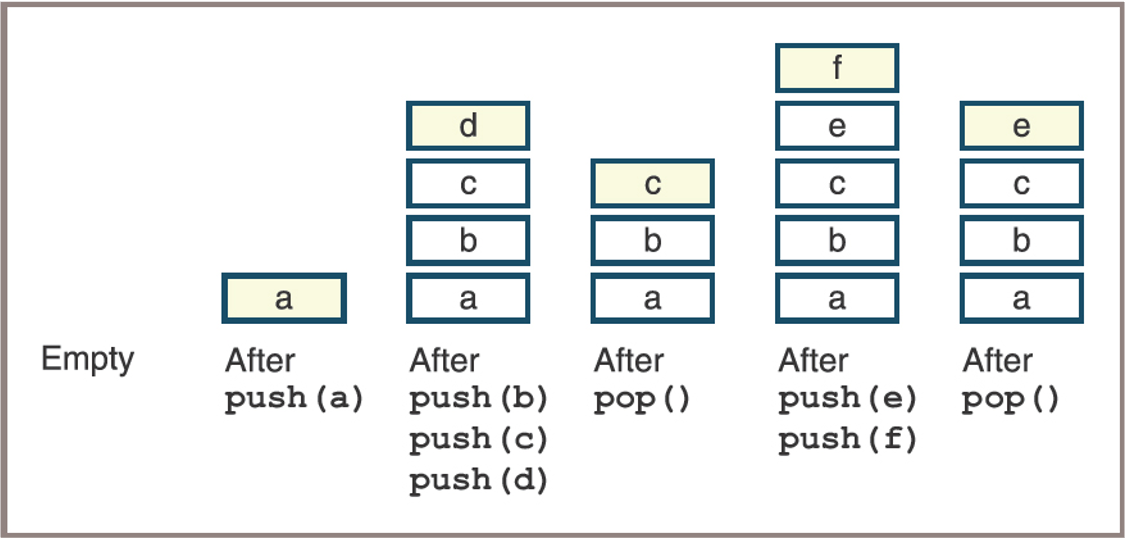
Overview of Stacks
- Operations
- Push: Add an item to the top of the stack.
- Pop: Remove the item from the top of the stack.
- Peek/Top: View the item at the top without removing it.
Common Application of Stacks in CS
- Function call management (call stack): managing computer memory in support of function and method calls
- Undo mechanisms in editors: word processors, spreadsheet programs, etc
- Syntax parsing (e.g., matching parentheses)
- Translating infix expressions to postfix form and evaluating postfix expressions
- Backtracking algorithms
- Maintaining a history of the links visited by a web browser
Using a Stack
- A stack type is not built into Python
- Programmers can use a Python list to emulate an array-based stack:
- The list method append pushes an element onto this stack
- The list method pop removes and returns the element at its top
- The main drawback of this option is as follows:
- All other list operations can manipulate the stack as well
Using a Stack
- To use a stack, you typically need to:
- Create an empty stack.
- Push items onto the stack as needed.
- Pop items off the stack when you need to process or remove them.
- Peek at the top item to see what is next to be processed (optional).
- Check if the stack is empty before popping or peeking.
The Stack Interface
- A stack typically provides the following interface:
- An operation named
peekfor examining the element at the top of a stack - The stack type can also include operations such as
clearisEmptylenstrin+
- An operation named
- These operations are listed as Python methods in next slide
The Stack Interface
| Stack Method | What It Does |
|---|---|
s.isEmpty() |
Returns True if s is empty or False otherwise. |
s.__len__() |
Same as len(s). Returns the number of items in s. |
s.__str__() |
Same as str(s). Returns the string representation of s. |
s.__iter__() |
Same as iter(s), or for item in s:. Visits each item in s, from bottom to top. |
s.__contains__(item) |
Same as item in s. Returns True if item is in s or False otherwise. |
s1.__add__(s2) |
Same as s1 + s2. Returns a new stack containing the items in s1 and s2. |
s.__eq__(anyObject) |
Same as s == anyObject. Returns True if s and anyObject are equal. |
s.clear() |
Makes s become empty. |
s.peek() |
Returns the item at the top of s. Precondition: s must not be empty; raises a KeyError if the stack is empty. |
s.push(item) |
Adds item to the top of s. |
s.pop() |
Removes and returns the item at the top of s. Precondition: s must not be empty; raises a KeyError if the stack is empty. |
Stack Operations: A walk-through
| Operation | State of Stack after the Operation | Value Returned | Comment |
|---|---|---|---|
s = <Stack Type>() |
Initially, stack is empty. | ||
s.push('a') |
a | The stack contains the single item. | |
s.push('b') |
ab | b is the top item. | |
s.push('c') |
abc | c is the top item. | |
s.isEmpty() |
abc | False | The stack is not empty. |
len(s) |
abc | 3 | The stack contains three items. |
s.peek() |
abc | c | Return the top item without removing it. |
Stack Operations: A walk-through
| Operation | State of Stack after the Operation | Value Returned | Comment |
|---|---|---|---|
s.pop() |
ab | c | Remove and return the top item. b is now the top item. |
s.pop() |
a | b | Remove and return the top item. a is now the top item. |
s.pop() |
a | Remove and return the top item. | |
s.isEmpty() |
True | The stack is empty. | |
s.peek() |
KeyError | Peeking at an empty stack raises an exception. | |
s.pop() |
KeyError | Popping an empty stack raises an exception. | |
s.push('d') |
d | d is the top item. |
Instantiating a Stack
- Later in this chapter, two different implementations are considered:
- ArrayStack
- LinkedStack
- For now, let us assume they are existing
- This code segment shows how you might instantiate them:
s1=ArrayStack ()s2=LinkedStack ([20, 40, 60])
- This code segment shows how you might instantiate them:
Stack Application: Matching Parentheses
- One classic application of stacks is checking for balanced parentheses (and other brackets) in expressions.
- Compilers need to determine if the bracketing symbols in expressions are balanced correctly
- The algorithm uses a stack to keep track of opening brackets as they appear.
- When a closing bracket is encountered, the stack is checked to ensure it matches the most recent opening bracket.
- The Table in the next slide provides some examples:
Matching Parentheses
- Balanced and Unbalanced Brackets in Expressions
| Example Expression | Status | Reason |
|---|---|---|
(…)….(…) |
Balanced | |
(…)….(… |
Unbalanced | Missing a closing ) at the end |
)…(...(…) |
Unbalanced | The closing ) at the beginning has no matching opening ( and one opening has no closing |
[…(…)…] |
Balanced | |
[…(…]…) |
Unbalanced | The bracketed sections are not nested properly |
Matching Parentheses
- To check an expression, take the following steps:
- Scan across the expression, pushing opening brackets onto a stack
- On encountering a closing bracket, if the stack is empty or if the item on the top of the stack is not an opening bracket of the same type, you know the brackets do not balance; therefore, you can quit the process and signal that the expression is improperly formed
- Otherwise, pop the item off the top of the stack and continue scanning the expression
- When you reach the end of the expression, the stack should be empty, and if it is not, you know the brackets do not balance
Stack Application:
- Three Areas:
- First, you’ll see algorithms for evaluating arithmetic expressions:
- These algorithms apply to problems in compiler design, and you will use them in the chapter’s case study
- Second, you’ll learn a general technique for using stacks to solve backtracking problems:
- The programming projects explore applications of the technique
- Third, you’ll witness the role of stacks in computer memory management
Evaluating Arithmetic Expressions (1/3)
- An indirect approach to evaluating arithmetic expressions works best:
- Transform an expression from its familiar infix form to a postfix form
- Evaluate the postfix form
- In the infix form, each operator is located between its operands In the postfix form, an operator immediately follows its operands
Evaluating Arithmetic Expressions (2/3)
- Some Infix and Postfix Expressions
| Infix Form | Postfix Form | Value |
|---|---|---|
| 34 | 34 | 34 |
| 34 + 22 | 34 22 + | 56 |
| 34 + 22 * 2 | 34 22 2 * + | 78 |
| 34 * 22 + 2 | 34 22 * 2 + | 750 |
| (34 + 22) * 2 | 34 22 + 2 * | 112 |
Evaluating Arithmetic Expressions (3/3)
- Consider the steps in evaluating the following:
Infixevaluation:34 + 22 * 2 → 34 + 44 → 78Postfixevaluation:34 22 2 * + → 34 44 + → 78
- The use of parentheses and operator precedence in
infixexpressions is for the convenience of the human beings who read them and write them - By eliminating these parentheses, The equivalent postfix expressions present a computer with a format that is much easier and more efficient for it to evaluate
Evaluating Postfix Expressions (1/2)
- Evaluating a postfix expression involves three steps:
- Scan across the expression from left to right
- On encountering an operator, apply it to the two preceding operands and replace all three by the result
- Continue scanning until you reach the expression’s end, at which point only the expression’s value remains
Evaluating Postfix Expressions (2/2)
Tracing the Evaluation of a Postfix Expression : 4 5 6 * +3 −
| Portion of Postfix Expression Scanned So Far | Operand Stack | Comment |
|---|---|---|
| No tokens have been scanned yet, so the stack is empty | ||
| 4 | 4 | Push the operand 4 |
| 4 5 | 4 5 | Push the operand 5 |
| 4 5 6 | 4 5 6 | Push the operand 6 |
| 4 5 6 * | 4 30 | Replace the top two operands by their product |
| 4 5 6 * + | 34 | Replace the top two operands by their sum |
| 4 5 6 * + 3 | 34 3 | Push the operand 3 |
| 4 5 6 * + 3 - | 31 | Replace the top two operands by their difference and pop the final value |
Converting Infix to Postfix (1/2)
- Detailed steps
- Start with an empty postfix expression and an empty stack, which will hold operators and left parentheses
- Scan across the infix expression from left to right
- On encountering an operand, append it to the postfix expression
- On encountering a left parenthesis, push it onto the stack
- On encountering an operator, pop off the stack all operators that have equal or higher precedence, append them to the postfix expression, and then push the scanned operator onto the stack
- On encountering a right parenthesis, shift operators from the stack to the postfix expression until meeting the matching left parenthesis, which is discarded
- On encountering the end of the infix expression, transfer the remaining operators from the stack to the postfix expression
Converting Infix to Postfix (2/2)
- Tracing the Conversion of an Infix Expression
4 + 5 * 6 − 3to a Postfix Expression
| Portion of Infix Expression Scanned So Far | Operator Stack | Postfix Expression | Comment |
|---|---|---|---|
| No tokens have been scanned yet, so the stack and PE are empty | |||
| 4 | 4 | Append 4 to the PE | |
| 4 + | + | 4 | Push + onto the stack |
| 4 + 5 | + | 4 5 | Append 5 to the PE |
| 4 + 5 * | + * | 4 5 | Push * onto the stack |
| 4 + 5 * 6 | + * | 4 5 6 | Append 6 to the PE |
| 4 + 5 * 6 − | − | 4 5 6 * + | Pop * and +, append them to the PE, and push – onto the stack |
| 4 + 5 * 6 − 3 | − | 4 5 6 * + 3 | Append 3 to the PE |
| 4 + 5 * 6 − 3 (end) | 4 5 6 * + 3 − | Pop the remaining operators off the stack and append them to the PE |