2025-09-24
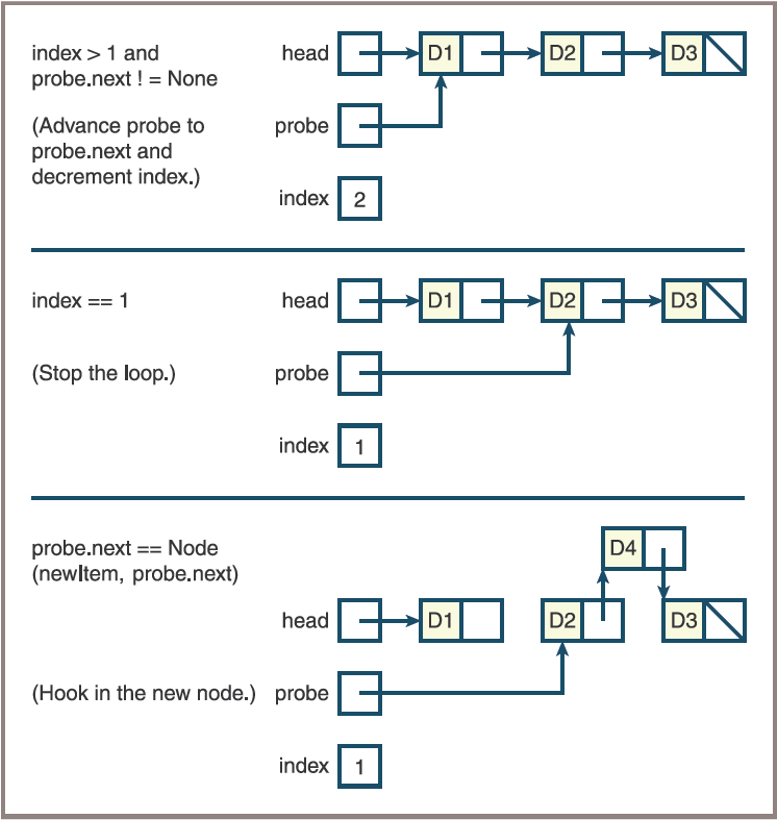
if head is None or index <= 0:
head = Node(newItem, head)
else:
# Search for node at position index - 1 or the last position
probe = head
while index > 1 and probe.next != None:
probe = probe.next
index -= 1
# Insert new node after node at position index - 1
# or last position
probe.next = Node(newItem, probe.next)# Assumes that the linked structure has at least one item
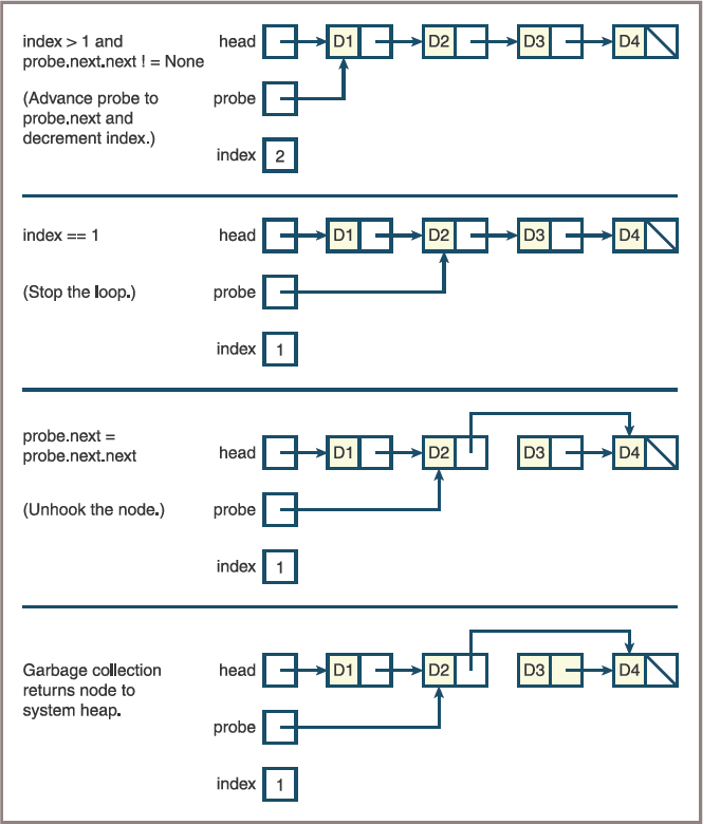
if index <= 0 or head.next is None:
removedItem = head.data
head = head.next
return removedItem
else:
# Search for node at position index - 1 or
# the next to last position
probe = head
while index > 1 and probe.next.next != None:
probe = probe.next
index -= 1
removedItem = probe.next.data
probe.next = probe.next.next
return removedItem| Operation | Running Time |
|---|---|
| Access (by position) | O(n) |
| Search (by value) | O(n) |
| Insertion at beginning | O(1) |
| Insertion at end | O(n) |
| Insertion at position i | O(n) |
| Removal at beginning | O(1) |
| Removal at end | O(n) |
| Removal at position i | O(n) |
The insertion and the removal of the first node are special cases of the insert ith and remove ith operations on singly linked structures:
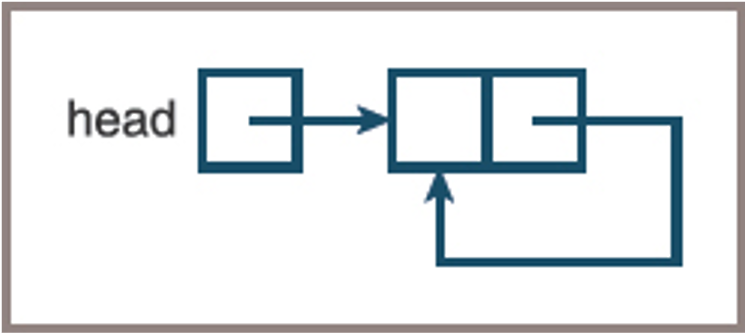
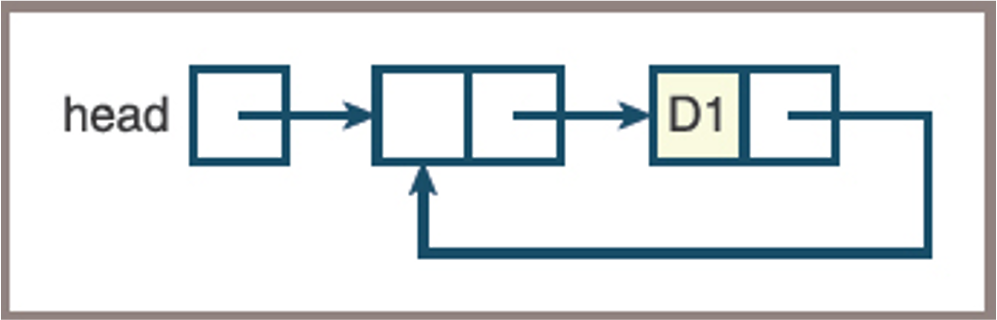
You can simplify these operations by using a circular linked structure with a dummy header node:
A circular linked structure with a dummy header node is a variation of a linked list where:
A circular linked structure contains a link from the last node back to the first node in the structure
Key Features:
Why use it?
head link is always pointed to the headerWhy keep a tail pointer?
class Node:
def __init__(self, data=None, next=None):
self.data = data
self.next = next
class CircularLinkedList:
def __init__(self):
# Create a dummy header node that points to itself
self.header = Node()
self.header.next = self.header
self.tail = self.header
def insert(self, data):
# Insert new node at the end (before header)
new_node = Node(data, self.header)
probe = self.header
while probe.next != self.header:
probe = probe.next
probe.next = new_node
self.tail = new_node
def remove(self, data):
# Remove first node with matching data
probe = self.header
while probe.next != self.header and probe.next.data != data:
probe = probe.next
if probe.next != self.header:
to_remove = probe.next
probe.next = to_remove.next
# If removing the tail, update tail
if to_remove == self.tail:
if probe == self.header:
# List is now empty
self.tail = self.header
else:
self.tail = probe
def print_last(self):
if self.tail == self.header:
print("List is empty")
else:
print(self.tail.data)
clist = CircularLinkedList()
clist.insert(10)
clist.insert(20)
clist.insert(30)
clist.insert(50)
clist.insert(60)
clist.remove(60)
clist.print_last()# Assuming we are using already existing header
def insert_at(self, index, data):
# Insert a new node with 'data' at position 'index'
probe = self.header
while index > 0 and probe.next != self.header:
probe = probe.next
index -= 1
# Insert new node after probe
new_node = Node(data, probe.next)
probe.next = new_node
# Update tail if inserted at the end
if new_node.next == self.header:
self.tail = new_nodeheader → 10 → 20 → 30 → 40 → (back to header)
If you call the remove(30) method, draw the circular linked structure before and after the removal.
Clearly label the header node, all data nodes, and show the direction of all next pointers.
Indicate which node is the header and which is the tail after the removal.

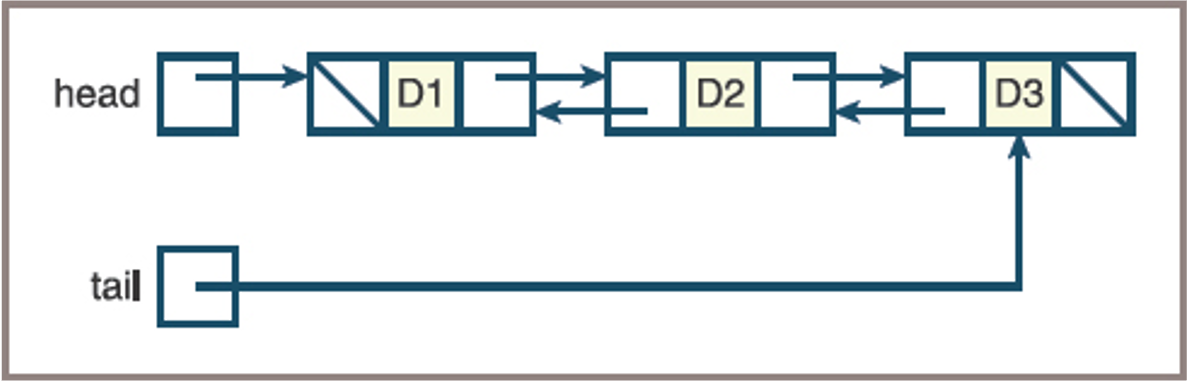
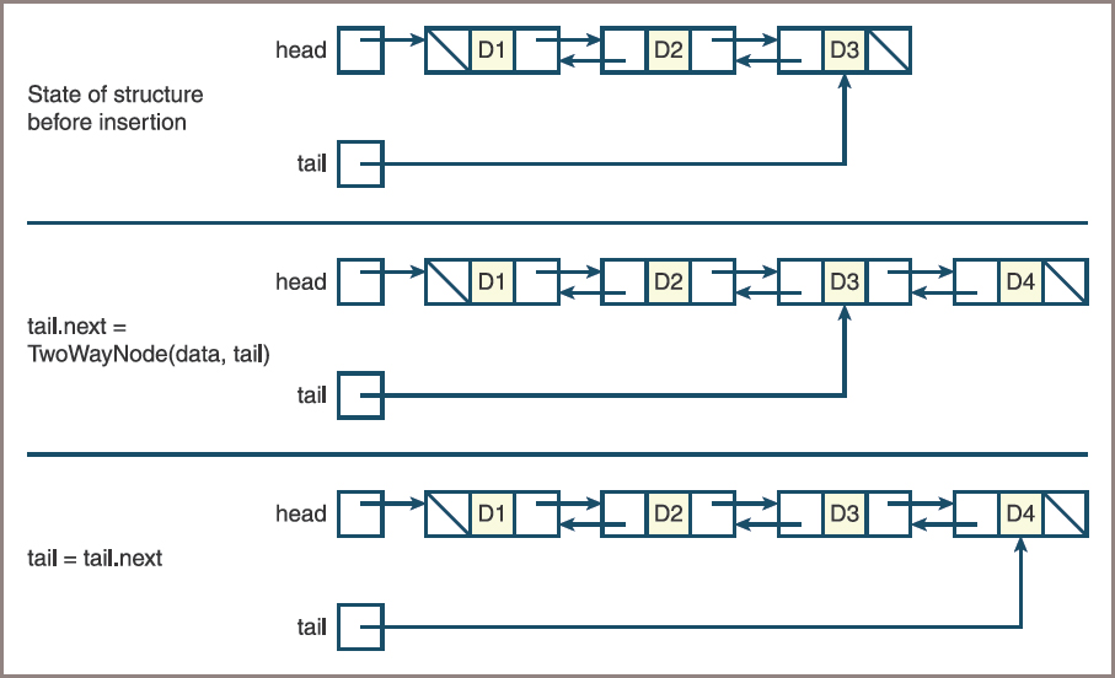
Note the presence of two pointers, conventionally known as next and previous, in each node
Note also the presence of a second external tail pointer that allows direct access to the last node in the structure
class Node(object):
def __init__(self, data, next = None):
"""Instantiates a Node with default next of None"""
self.data = data
self.next = next
class TwoWayNode(Node):
def __init__(self, data, previous = None, next = None):
"""Instantiates a TwoWayNode."""
Node.__init__(self, data, next)
self.previous = previous