TREES STRUCTURE (2)
Fred Agbo
2025-11-03
Announcements
- Welcome to New Month and week 11!
- We continue to discuss
TreesStructure- Readings:
- FDS - Lambert: Chapter 10
- DS&A - John et al.: Chapter 8, 9
- Readings:
- Problem set 4 is due today at 10pm
Common Applications of Binary Trees
Common Applications of Binary Trees
Heaps: Specialized binary trees used to implement priority queues.
Binary Search Trees (BST): Efficiently support dynamic set operations such as search, insert, and delete.
Expression Trees: Used to represent arithmetic expressions, where leaves are operands and internal nodes are operators.
Huffman Coding Trees: Used in data compression algorithms to generate prefix codes.
Syntax Trees: Used in compilers to represent the structure of program code.
File System Indexing: Some file systems use binary trees for efficient file lookup.
Routing Tables: Used in networking for efficient IP routing and searching.
We will discuss the first three
Heaps
- A heap is a specialized binary tree-based data structure that satisfies the heap property:
- In a max-heap, for every node, the value of the node is greater than or equal to the values of its children.
- In a min-heap, for every node, the value of the node is less than or equal to the values of its children.
- Heaps are commonly implemented as complete binary trees, meaning all levels are fully filled except possibly the last, which is filled from left to right.
Types of Heaps
- Min-Heap
- The smallest element is at the root.
- Every parent node has a value less than or equal to its children.
- Used for priority queues where minimum element removal is required (e.g., Dijkstra’s algorithm).
- Max-Heap
- The largest element is at the root.
- Every parent node has a value greater than or equal to its children.
- Used in algorithms like Heap Sort and for implementing priority queues where maximum element removal is required.
- Either constraint on the order of the nodes is called the heap property
Heap Operations
- Insertion: Add the new element at the end (maintaining completeness), then “heapify up” to restore the heap property.
- Deletion (usually root): Remove the root, replace it with the last element, then “heapify down” to restore the heap property.
- Peek: Access the root element (max or min) in constant time.
Applications of Heaps
- Implementing priority queues
- Heap sort algorithm
- Algorithm that builds a heap from a set of data and then repeatedly removes the root item and adds it to the end of a list
- Graph algorithms (e.g., Dijkstra’s shortest path)
- Order statistics (finding kth largest/smallest element)
Examples of Heaps
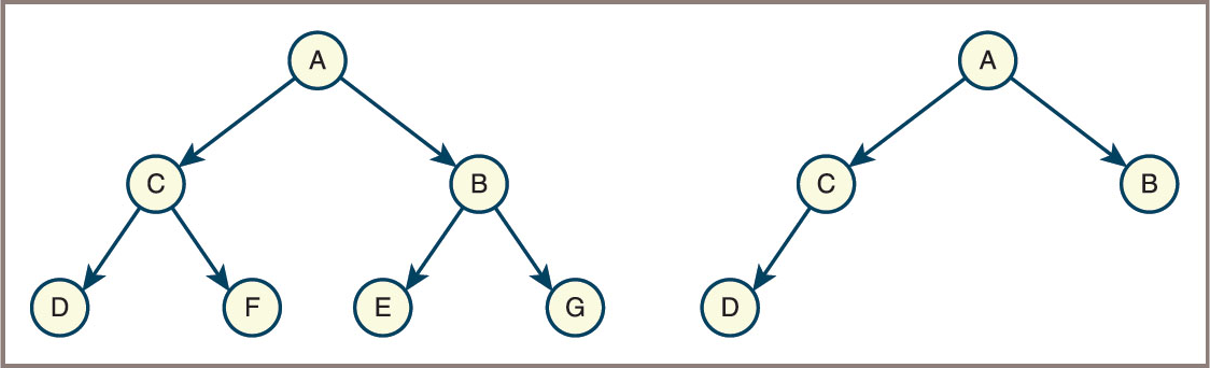
- Examples of a min-heap
- Draw the diagram to showcase an example of maz-heap
- following the contraint on the order of its nodes
Binary Search Trees (BST)
- A Binary Search Tree (BST) is a binary tree in which each node has a key, and:
- The key in each node is greater than all keys in its left subtree.
- The key in each node is less than all keys in its right subtree.
Keyin this case is the value used for ordering- It can be the data stored itself (if simple values such as integer) or attribute/reference key used for comparison
- BSTs efficiently support dynamic set operations:
- Search: Find if a value exists in O(h) time, where h is the height of the tree.
- Insert: Add a new value while maintaining the BST property.
- Delete: Remove a value and restructure the tree if necessary.
BST Example
- The possible search paths for the binary search of a sorted list
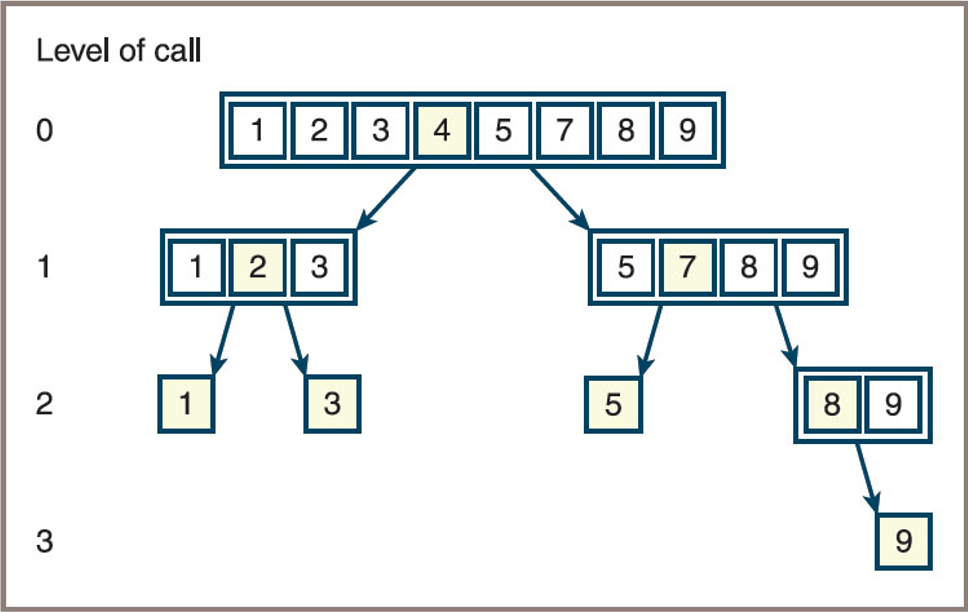
BST Example
- Binary Search Tree
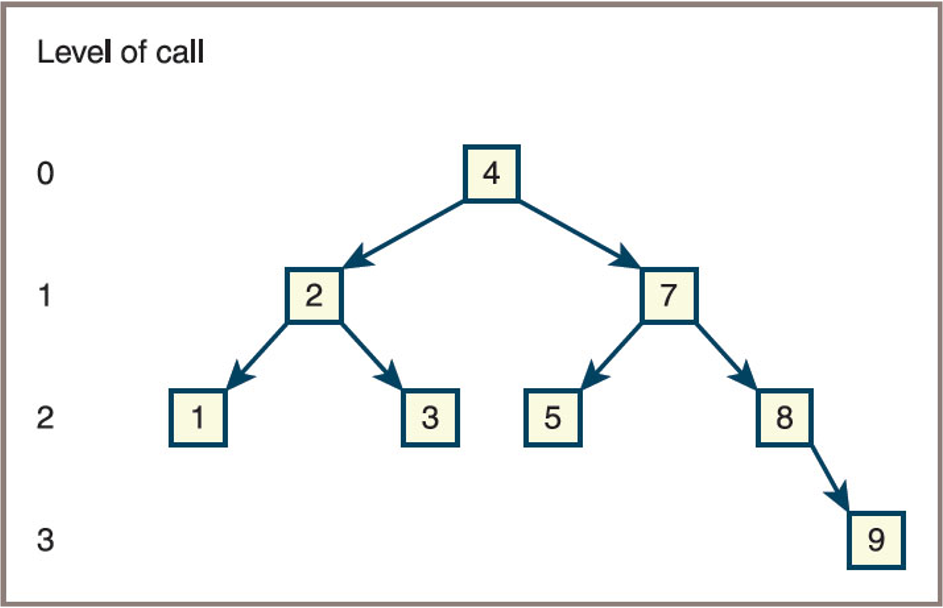
BST Interface
- A binary search tree imposes a special ordering on the nodes in a binary tree
- So it supports logarithmic searches and insertions
- The
interfacefor a BST should include aconstructorand the basic operations common to all collectionsisEmpty,len,str,+,==,in,add, andcount
- As with bags
- Insertions and removals are accomplished by the
addandremovemethods
- Insertions and removals are accomplished by the
- The method
__contains__- Performs a binary search in any BST implementation
BST Interface
- To allow users to retrieve and replace items in a binary search tree, the methods
findandreplaceare also included.- The method
findexpects an item as an argument and returns the item matching it in the tree, orNoneotherwise - The method
replaceexpects two items as arguments
- The method
- Because there are four ways to traverse a binary tree
- You include methods for each one
- Each traversal method returns an iterator
- The tree’s
__iter__method supports a preorder traversal
- The tree’s
- Two trees are considered equal if they contain the same items in the same positions
- The
stroperation returns a string that shows the shape of the tree when printed.
BST Interface (Part 1)
| Method | What It Does |
|---|---|
tree.isEmpty() |
Returns True if tree is empty, False otherwise. |
tree.__len__() |
Same as len(tree). Returns the number of items in the tree. |
tree.__str__() |
Same as str(tree). Returns a string showing the shape of the tree when printed. |
tree.__iter__() |
Same as iter(tree) or for item in tree:. Performs a preorder traversal on the tree. |
tree.__contains__(item) |
Same as item in tree. Returns True if item is in the tree, False otherwise. |
tree.__add__(otherTree) |
Same as tree + otherTree. Returns a new tree containing items from both trees. |
tree.__eq__(anyObject) |
Same as tree == anyObject. Returns True if trees are equal (same items in corresponding positions). |
BST Interface (Part 2)
| Method | What It Does |
|---|---|
tree.clear() |
Makes the tree become empty. |
tree.add(item) |
Adds item to its proper place in the tree. |
tree.remove(item) |
Removes item from the tree. Precondition: item is in the tree. |
tree.find(item) |
Returns the matched item if found, otherwise returns None. |
tree.replace(item, newItem) |
Replaces matched item with newItem and returns the matched item, else returns None. |
tree.preorder() |
Returns an iterator for preorder traversal. |
tree.inorder() |
Returns an iterator for inorder traversal. |
tree.postorder() |
Returns an iterator for postorder traversal. |
tree.levelorder() |
Returns an iterator for level order traversal. |
Steps for Implementing Linked-Based BST
Implementing a Linked-Based BST
Step 1: Define the BSTNode Class
- Represents a single node in the BST.
- Contains fields for the data, left child, and right child.
Step 1: Define the BSTNode Class
Implementing a Linked-Based BST
Step 2: Create the BSTInterface
- Specifies the required methods for any BST implementation (e.g.,
add,remove,find,traversalmethods). - Can be defined as an abstract base class.
Step 2: Create the BSTInterface
"""
File: BSTinterface.py
Author: Ken Lambert
"""
class BSTInterface(object):
    """Interface for all binary search trees."""

    # Constructor
    def __init__(self, sourceCollection = None):
        """Sets the initial state of self, which includes the
        contents of sourceCollection, if it's present."""
        pass

    # Accessor methods
    def isEmpty(self):
        """Returns True if len(self) == 0, or False otherwise."""
        return True

    def __len__(self):
        """-Returns the number of items in self."""
        return 0

    def __str__(self):
        """Returns the string representation of self."""
        return ""

    def __iter__(self):
        """Supports a preorder traversal on a view of self."""
        return None

    def inorder(self):
        """Supports an inorder traversal on a view of self."""
       return None

    def postorder(self):
        """Supports a postorder traversal on a view of self."""
        return None

    def levelorder(self):
        """Supports a levelorder traversal on a view of self."""
        return None

    def __add__(self, other):
        """Returns a new bag containing the contents
        of self and other."""
        return None

    def __eq__(self, other):
        """Returns True if self equals other,
        or False otherwise."""
        return False

    def __contains__(self, item):
        """Returns Ture if item is in self, or
        False otherwise."""
        return True

    def find(self, item):
        """If item matches an item in self, returns the
        matched item, or None otherwise."""
        return None

    # Mutator methods
    def clear(self):
        """Makes self become empty."""
        pass

    def add(self, item):
        """Adds item to self."""
        pass

    def remove(self, item):
        """Precondition: item is in self.
        Raises: KeyError if item is not in self.
        postcondition: item is removed from self."""
        pass

    def replace(self, item, newItem):
        """Precondition: item == newItem.
        Raises: KeyError if item != newItem.
        If item is in self, replaces it with newItem and
        returns the old item, or returns None otherwise."""
        return None
Implementing a Linked-Based BST
Step 3: Implement AbstractCollection
- Provides basic collection behaviors (e.g.,
isEmpty,__len__,clear).
Step 3: Implement AbstractCollection
"""
File: abstractcollection.py
Author: Ken Lambert
"""
class AbstractCollection(object):
    """An abstract collection implementation."""

    # Constructor
    def __init__(self, sourceCollection = None):
        """Sets the initial state of self, which includes the
        contents of sourceCollection, if it's present."""
        self.size = 0
        if sourceCollection:
            for item in sourceCollection:
                self.add(item)

    # Accessor methods
    def isEmpty(self):
        """Returns True if len(self) == 0, or False otherwise."""
        return len(self) == 0

    def __len__(self):
        """Returns the number of items in self."""
        return self.size

    def __str__(self):
        """Returns the string representation of self."""
        return "[" + ", ".join(map(str, self)) + "]"

    def __add__(self, other):
        """Returns a new bag containing the contents
        of self and other."""
        result = type(self)(self)
        for item in other:
            result.add(item)
        return result

    def __eq__(self, other):
        """Returns True if self equals other,
        or False otherwise."""
        if self is other: return True
        if type(self) != type(other) or \
           len(self) != len(other):
            return False
        otherIter = iter(other)
        for item in self:
            if item != next(otherIter):
                return False
        return True

    def count(self, item):
        """Returns the number of instances of item in self."""
        total = 0
        for nextItem in self:
            if nextItem == item:
                total += 1
        return total
Implementing a Linked-Based BST
Step 4: Implement the LinkedBST Class
- Inherit from BSTInterface and AbstractCollection.
- Use BSTNode for the tree structure.
- Implement all required BST operations (add, remove, find, traversals, etc.).
Step 4: Implement the LinkedBST Class
"""
File: linkedbst.py
Author: Ken Lambert
"""
from abstractcollection import AbstractCollection
from bstnode import BSTNode

class LinkedBST (AbstractCollection):
    """An link-based binary search tree implementation."""

    def __init__(self, sourceCollection = None):
        """Sets the initial state of self, which includes the
        contents of sourceCollection, if it's present."""
        self.root = None
        AbstractCollection.__init__(self, sourceCollection)

        # Implement add, remove, find, __contains__, __iter__, etc.
Implementing a Linked-Based BST
Step 5 & 6:
- Implement Traversal Methods
Preorder,inorder,postorder, andlevel ordertraversals as generator methods.
- Test the Implementation
- Create instances, add/remove/find items, and verify traversals.
Searching a Binary Search Tree
- The
findmethod returns the first matching item if the target item is in the tree - Otherwise, it returns None
- Pseudocode algorithm for this process:
Traversing a Binary Search Tree
The String Representation of BST
- Code that builds the appropriate string by first recusing with the right subtree, then visiting an item, and finally recursing with the left subtree:
def __str__(self):
    """Returns a string representation with the tree rotated
    90 degrees counterclockwise."""
    def recurse(node, level):
        s = ""
        if node != None:
            s += recurse(node.right, level + 1)
            s += "| " * level
            s += str(node.data) + "\n"
            s += recurse(node.left, level + 1)
        return s
    return recurse(self.root, 0)
Inserting an Item into BST
- The
addmethod inserts an item into its proper place in the binary search tree - An item’s proper place will be in one of three positions:
- The root node, if the tree is already empty
- A node in the current node’s left subtree, if the new item is less than the item in the current node
- A node in the current node’s right subtree, if the new item is greater than or equal to the item in the current node
- For the second and third options, the
addmethod uses a recursive helper function namedrecurse
Inserting an Item into BST
- Code for the add method:
def add(self, item):
    """Adds item to the tree."""

    # Helper function to search for item’s position
    def recurse(node):
        # New item is less; go left until spot is found
        if item < node.data:
            if node.left == None:
                node.left = BSTNode(item)
            else:
                recurse(node.left)
        # New item is greater or equal;
        # go right until spot is found
        elif node.right == None:
            node.right = BSTNode(item)
        else:
            recurse(node.right)
        # End of recurse

    # Tree is empty, so new item goes at the root
    if self.isEmpty():
        self.root = BSTNode(item)
    # Otherwise, search for the item’s spot
    else:
        recurse(self.root)
    self.size += 1
Removing an Item from a BST
- Save a reference to the root node
- Locate the node to be removed, its parent, and its parent’s reference to this node
- If the node has a left child and a right child, replace the node’s value with the largest value in the left subtree and delete that value’s node from the left subtree
- Otherwise, set the parent’s reference to the node to the node’s only child
- Reset the root node to the saved reference
- Decrement the size and return the item
Complexity Analysis of BST
- Optimal behavior depends on the height of the tree
- Run time of insertions is also highly dependent on the height of the tree
- Removals also require a search for the target item
- Strategies for maintaining a tree structure that supports optimal insertions and searches in all cases
- Are the subject of advanced computer science courses