Stepwise Refinement

Fred Agbo

August 31, 2026

Happy New Week!!

Announcements

  • Remember, problem Set 1 is due on Monday Sept. 7th @ 10pm!
  • Small sections started this week. Keep attending
    • Remember! The channel for getting help is Section leaders, QUAD, Instructors
    • Did you not get a message from Prof. Jed about your section meeting time?
      • Come see me after class and we can see about getting you placed into one.
  • Welcome to TechByte event tomorrow Tuesday September 1 by 12 pm @ Ford 102.

Group Problems Activity

Preliminaries

  • Take a quick moment to introduce yourself to your group-mates for the day
    • Name
    • Class year
    • Major?

Considerations

  • Don’t forget about decomposition!
  • For all code writing questions today, try to think about how you could decompose it into at least two parts
    • Frequently, you’ll be able to reuse one of those parts!
  • You already got the repository of worlds for today’s problems here
    • Not required, but there if you want to be able to test solutions

Problem 1: Wondering Karel

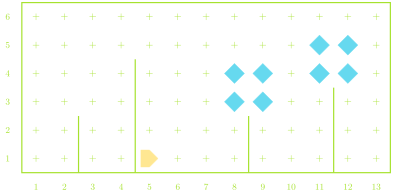
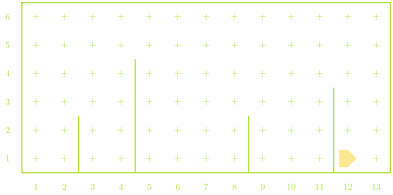
Karel starts as shown to the right. At which beeper do they end up when the below sequence of commands finishes?

while no_beepers_present():
    while front_is_clear():
        move()
        if beepers_present():
            turn_left()
        else:
            turn_right()
    turn_left()

Problem 2: The Race

  • Karel starts at the bottom of a world facing north
  • There are exactly two stacks of beepers placed somewhere above them
  • To win the race Karel needs to pick up both stacks of beepers and then touch the North wall
    • Remember that Karel can only pick up one beeper at a time!

Live-Coding: More Bars in More Places

  • A line of stacks of beepers goes across the bottom of Karel’s world
  • Karel’s job is to spread each stack out on the corresponding avenue, with 1 beeper on each street, starting from 1st street
  • You don’t know how big the world is, or how many beepers might be in each stack
    • But there will be fewer beepers than the height of the world
  • Karel always starts from the lower right facing west

Visualized

A Narrow Path - Practice Problem

  • There is a beeper path that extends from one side of the world to the other
  • Karel starts on one end, facing toward the first beeper
  • Goal is to follow the path to the other end

Stepwise Refinement

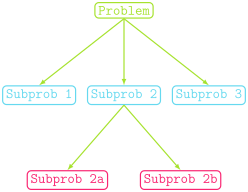
  • The most successful way to solve a complex problem is to break it down into progressively simpler problems
  • Begin by breaking the whole problem into a few simpler parts
    • Some of these parts might then need further breaking down into even simpler parts
  • The process is commonly called stepwise refinement or decomposition
Excellent Decomposing

  • A good problem decomposition should mean:

    The proposed pieces should be easy to explain
    One indication that you have succeeded is if it is easy to give them simple names
    The steps are as general as possible
    Each piece of code you can reuse is one less piece of code you need to write! If your steps solve general tasks, they are much easier to reuse.
    The steps should make logical sense for the problem you are solving
    If you have a function that will work to solve a step but was designed (and named) with something else entirely in mind, adopt it for the currently needed situation

Enter the Winter

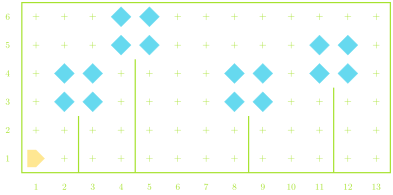
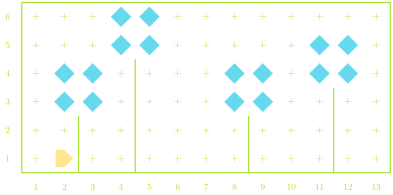
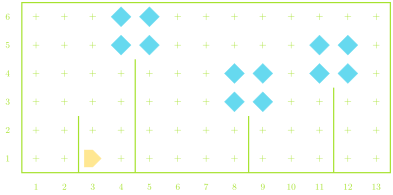
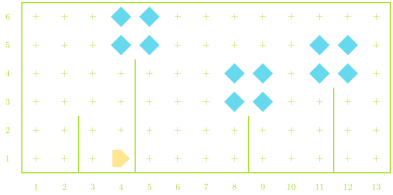
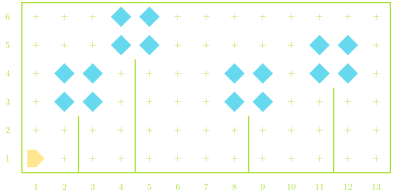
  • Suppose we want Karel to usher in the Fall/Winter by removing the “leaves” from the tops of all the trees
Understanding the Problem

  • What are we guaranteed by the problem?
  • How will we know when we are done?

Understanding the Problem

  • There are four trees in this problem
  • We need to find a tree at a time
  • We need to remove the leaves
    • there are four leaves per tree

Top-Level Decomposition

  • We could break this problem into two main subproblems:
    1. Find the next tree
    2. Strip the leaves off that tree

Top-Level Decomposition

  • We could break this problem into two main subproblems:
    1. Find the next tree
    2. Strip the leaves off that tree

Top-Level Decomposition

  • We could break this problem into two main subproblems:
    1. Find the next tree
    2. Strip the leaves off that tree

Top-Level Decomposition

  • We could break this problem into two main subproblems:
    1. Find the next tree
    2. Strip the leaves off that tree

Top-Level Decomposition

  • We could break this problem into two main subproblems:
    1. Find the next tree
    2. Strip the leaves off that tree

Top-Level Decomposition

  • We could break this problem into two main subproblems:
    1. Find the next tree
    2. Strip the leaves off that tree

Top-Level Decomposition

  • We could break this problem into two main subproblems:
    1. Find the next tree
    2. Strip the leaves off that tree

Top-Level Decomposition

  • We could break this problem into two main subproblems:
    1. Find the next tree
    2. Strip the leaves off that tree

Top-Level Decomposition

  • We could break this problem into two main subproblems:
    1. Find the next tree
    2. Strip the leaves off that tree

Remember Your Algorithms!

  • Algorithmic design: The process of designing a solution strategy to a problem
  • An algorithm is just an approach or recipe for a method to solve a particular problem
    • Frequently language agnostic
  • Can you design algorithm to address the Fall/Winter problem?

Algorithm ⮕ Code

  • for four iterations
    • find a tree
    • then remove leaves
  • while the front is clear
    • keep moving
  • move up the tree
  • remove each leaf
  • move down the tree

Algorithm ⮕ Code

import karel
def main():
    # Here is our general solution with higher level of decomposition
    for i in range(3):
        find_next_tree()
        remove_leaves()
def find_next_tree():
    # the codes to find next tree
    while front_is_clear():
        move()
def remove_leaves():# codes to remove leaves
    move_up()
    deleaf()
    move_down()
  • moving up
def move_up():
    turn_left()
    while right_is_blocked():
        move()
  • deleafing
def deleaf():
    pick_beeper()
    for i in range(3):
        move()
        pick_beeper()
        turn_right()
    turn_left()
  • moving down
def move_down():
    while front_is_clear():
        move()
    turn_left()
// reveal.js plugins